
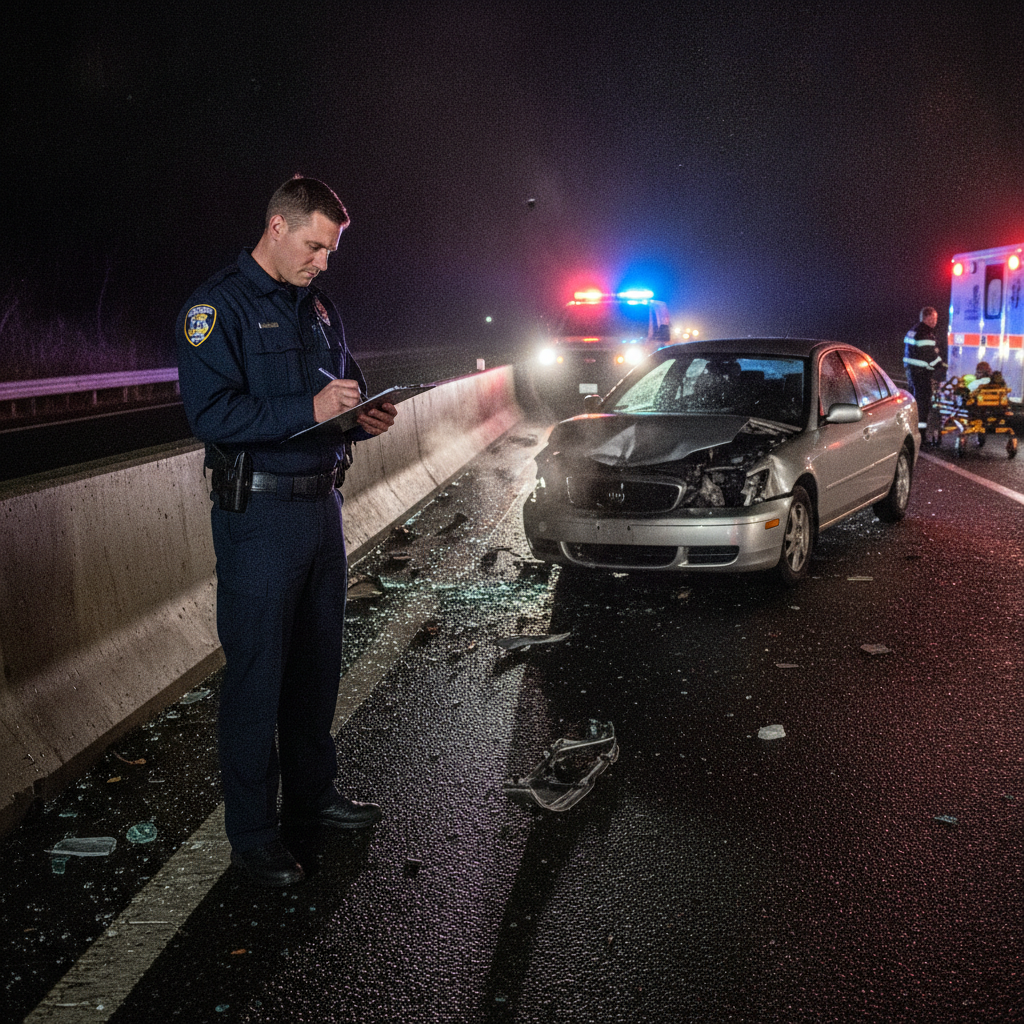
The Police Report Is Not Your Case. Here's What Actually Determines Your Value.
Personal Injury Law | San Antonio, Texas
By Steven A. Lopez | Personal Injury Attorney, San Antonio, Texas
After an accident in San Antonio, the police report feels like the finish line. You call, they come, they document what happened, and you think: the record is there. The truth is on paper. Now the insurance company will do the right thing.
That's not how it works.
I've handled personal injury cases my entire career. I've had cases where the police report was perfect, liability was crystal clear, and the outcome was still terrible. I've seen the opposite too. The police report is a starting point. Nothing more.
If you've been injured and you're waiting for the police report to do the heavy lifting for you, your work is not done. It's just beginning.
What a Police Report Actually Does
A police report documents the responding officer's observations at the scene. It records the basic facts: who was involved, what vehicles, what location, what time. It may include a preliminary assessment of fault based on statements from drivers and witnesses present at the scene.
That preliminary assessment carries weight, but it is not binding. It is one officer's read of a situation, gathered under pressure, often within minutes of arrival, based on whatever information was available at that moment.
Insurance companies review police reports. Attorneys review police reports. Judges and juries see them too. But none of them treat the police report as the final word on what your case is worth. Neither should you.
What the report does not capture is the thing that actually drives the value of a personal injury claim: the full extent of what this accident did to your body, your ability to work, and your quality of life.
Liability Opens a Door. Your Injuries Walk You Through It.
I always say, "Liability opens a door, but it's your injuries that walk you through it."
This is the most important thing I can tell any injured person in Bexar County or anywhere else: winning the liability argument gets you into the room. It does not determine what happens once you're there.
Think of it this way. Two people are rear-ended at a stoplight on Loop 410. Same intersection, same type of crash, same police report showing the other driver at fault. One person walks away sore but recovers in two weeks. The other suffers a herniated disc that requires surgery and keeps them out of work for four months. Same liability. Completely different cases. Completely different values.
The police report is identical in both situations. The medical records are not. And the medical records are what determine the money.
Why Your Medical Records Matter More Than the Narrative
Insurance adjusters are trained to minimize payouts. One of the most effective tools they have is pointing to gaps between what you say happened and what your medical records actually show.
If you say you were seriously hurt but you didn't seek treatment until two weeks after the accident, the adjuster will use that gap. If you say your back has never been the same but your records show you stopped going to physical therapy after three visits, they will use that too. If you told the emergency room you were feeling okay and then later claim significant injury, that inconsistency becomes a problem.
Your medical records are the evidence. They are the paper trail that connects the accident to your injury and your injury to your loss. Without that trail, even a perfect police report in your favor will not get you fair compensation.
This is why the steps you take in the days and weeks after an accident in San Antonio matter as much as what happened at the scene.
What to Do After the Police Report Is Filed
The report is done. Now here is where your actual case gets built or lost.
Seek medical attention immediately, even if you feel like you might be okay. Adrenaline masks pain. Soft tissue injuries and herniated discs often don't fully announce themselves until 24 to 72 hours after impact. Getting evaluated creates a record that connects your injuries to the accident. Waiting creates a gap that works against you.
Follow through on every referral. If your doctor sends you to a specialist, go. If they recommend physical therapy, complete it. Stopping treatment early signals to the insurance company that you weren't as hurt as you claimed, regardless of whether that's true.
Document your daily experience. Keep notes on how your injuries are affecting your life. Sleep, mobility, your ability to do your job, activities you can no longer do with your family. This is called pain and suffering documentation, and it is evidence.
Do not give a recorded statement to the other driver's insurance company without speaking to a personal injury attorney first. They are not trying to help you. They are trying to build a record they can use to reduce what they owe you.
I've Handled Perfect Cases with Terrible Outcomes
I want to be direct about something, because I think injured people deserve honesty over false reassurance.
I have handled cases where the police report was unambiguous, liability was not in dispute, and the case still didn't produce the result my client deserved. Why? Because the medical documentation wasn't there. Because treatment was delayed or inconsistent. Because the connection between the accident and the injury wasn't airtight on paper.
The narrative of what happened matters less than the evidence of what it cost you. A clear police report with weak medical records will lose to a disputed police report with thorough, consistent, well-documented medical treatment every time.
That's a hard truth. But it's the truth that protects you if you know it early enough to act on it.
FAQs: Police Reports and Personal Injury Claims in Texas
Does a police report determine who is at fault in a Texas personal injury case?
No. A police report reflects the responding officer's observations and preliminary conclusions. It is one piece of evidence among many. Insurance companies, attorneys, and courts all review police reports, but they also consider witness statements, photos, surveillance footage, accident reconstruction, and medical records. A police report that places fault on the other driver is helpful. It is not automatically decisive.
What if the police report is wrong or inaccurate?
Police reports can be disputed. If the officer's narrative contains factual errors, you can request a correction through the reporting agency. You can also present additional evidence, including witness statements and photos, that contradicts the report's findings. An experienced San Antonio personal injury attorney can help you identify what to challenge and how to build an alternative evidentiary record.
How soon after an accident should I see a doctor in Texas?
As soon as possible, ideally the same day. Delaying medical treatment is one of the most damaging things an injured person can do to their own case. Insurance companies treat gaps in treatment as evidence that you were not seriously hurt. Even if you feel like you might be fine, get evaluated. The documentation you create in those first 24 to 72 hours can make or break the injury portion of your claim.
What medical records do I need for a personal injury claim?
All of them. Emergency room records, primary care visits, specialist referrals, imaging results like X-rays and MRIs, physical therapy notes, and any mental health treatment related to the accident. The more complete your medical paper trail, the stronger the connection between the accident and your documented injuries. Your attorney will help gather and organize these records as part of building your claim.
Can I still recover compensation if liability is disputed?
Yes. Disputed liability cases go to negotiation and sometimes litigation. In Texas, the modified comparative fault rule allows you to recover damages as long as you are found to be 50% or less responsible for the accident. Your compensation is reduced by your percentage of fault, but you are not automatically barred from recovery just because the other side is pushing back on the liability question.
Do I need a personal injury attorney in San Antonio even if the police report is in my favor?
Yes, and especially then. A favorable police report can give injured people a false sense of security. They assume the insurance company will offer fair compensation and skip the step of consulting an attorney. That assumption costs people money. Insurance adjusters work for the insurance company, not for you. An attorney works for you, and the consultation is free.
The Bottom Line
The police report opens the door. What you do after the accident determines whether you walk through it with a fair result or leave money on the table because the evidence wasn't there to support what your injuries actually cost you.
If you've been in an accident in San Antonio, in Bexar County, or anywhere in South Texas, and you're trying to figure out where you stand, start with a conversation before you start making assumptions about what your case is worth.
We offer free consultations. We work on contingency. And we will give you an honest assessment of your case, not just the parts you want to hear.
Schedule a free consultation with our San Antonio personal injury team. You pay nothing unless we win.