
The Texas Law That Can Cut Your Accident Settlement, Even When You Weren't at Fault
By Steven A. Lopez | Personal Injury Attorney, San Antonio, Texas
Most drivers in San Antonio have never heard of proportionate responsibility. Insurance companies have. They use it on nearly every claim that crosses their desk, and they use it whether the crash happened on Loop 410, in the Medical Center area, or on a quiet street off the highway.
This law can reduce what you collect after a wreck, even when the other driver was clearly the one who caused it. Here is how it works, and why the first statement you give an adjuster matters more than most people realize.
What Proportionate Responsibility Actually Means
Texas follows a rule sometimes called comparative fault. The legal name is proportionate responsibility, and it is written into the Texas Civil Practice and Remedies Code, Chapter 33.
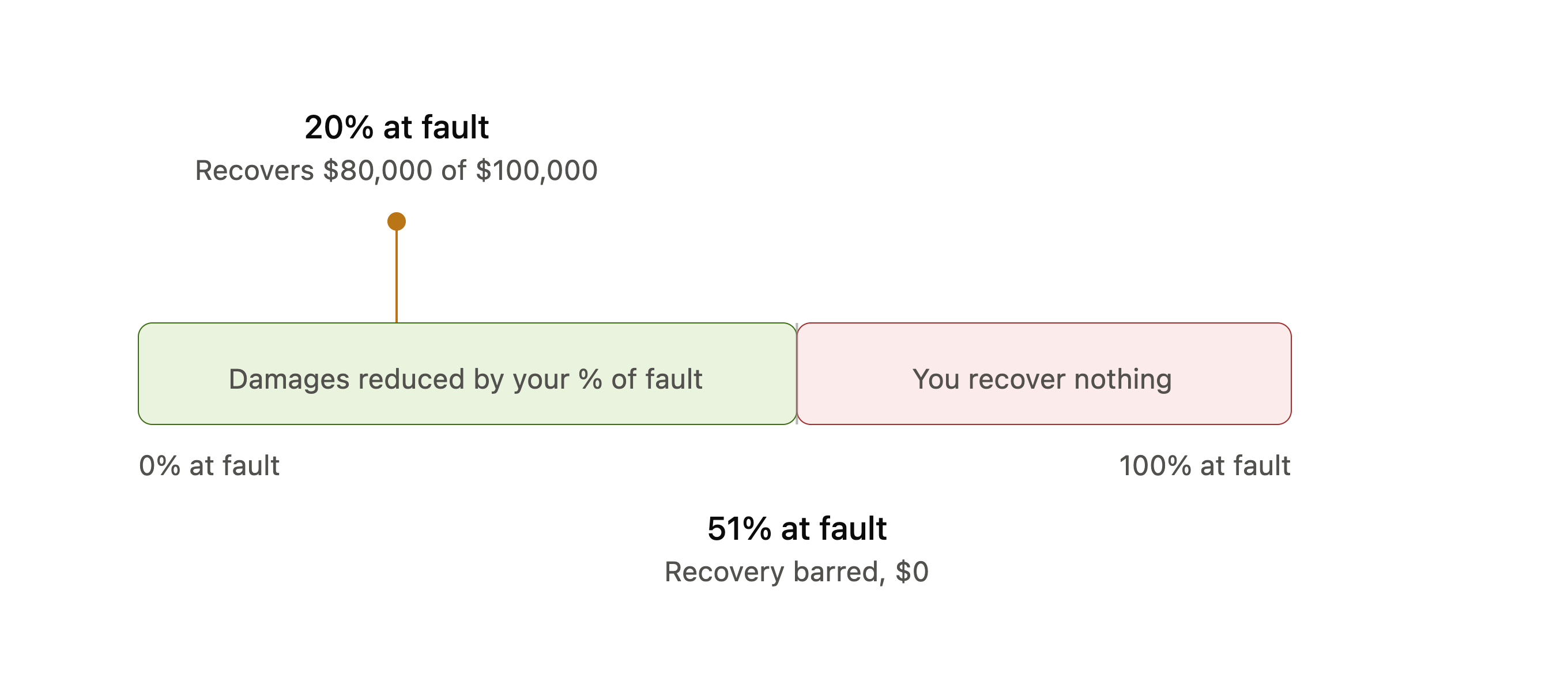
Here is the basic idea. If you are found partly responsible for the accident that hurt you, your damages get reduced by your percentage of fault.
Say a jury decides you were 20 percent responsible for a crash and your medical bills came to $100,000. You do not collect $100,000. You collect $80,000.
Now push that further. If your share of fault is found to be 51 percent or more, Texas law bars you from collecting anything at all. Not a reduced amount. Nothing.
That single number, 51 percent, is the line insurance adjusters are working toward from the moment they open your file.
Why Insurance Companies Build Their Entire Strategy Around This Rule
Adjusters are trained on proportionate responsibility the way attorneys are. Often better, because it is the single most useful tool they have to shrink a payout without ever denying the claim outright.
An insurance company does not need to prove you caused the wreck. It only needs to find some percentage of fault it can attach to you. Every point of fault they add to your side is a point they subtract from the check they eventually write.
So they go looking. Your speed in the seconds before impact. Whether you glanced at your phone. Whether you hesitated half a second at a green light. Whether you were changing lanes, even if the other driver ran the red.
None of this has to be the main cause of the crash. It only has to be a contributing factor a jury could plausibly assign a percentage to.
Why This Makes Early Statements to Adjusters So Risky
This is where a lot of San Antonio accident victims get hurt a second time, financially, after the crash itself.
An adjuster calls within a day or two, sounding friendly and routine. They ask what happened, how fast you were going, whether you saw the other car coming. Every answer gets recorded and run through the same framework: how much of this can we attribute to the person we're talking to.
The question the adjuster is actually asking is rarely who caused the accident. It is how much of the accident they can pin on you. A casual, unprepared statement is exactly what gives them the material to do it.
This is not a reason to lie or refuse to cooperate with a legitimate investigation. It is a reason to know what you are walking into before you say anything on the record.
How This Plays Out in Bexar County Cases
In practice, proportionate responsibility shows up in almost every contested claim I handle in Bexar County and across South Texas. A rear-end collision on I-10 gets complicated by an argument that the lead driver braked unnecessarily. A pedestrian hit near the Medical Center gets a fault argument built around jaywalking, even a few feet from a marked crosswalk.
None of these arguments require the insurance company to be right. They only need a jury or an adjuster to find them credible enough to assign a percentage. That percentage comes directly out of your recovery.
What You Can Do to Protect Your Claim
- Get medical care immediately and keep every record. Gaps and inconsistencies are exactly what fault arguments are built on.
- Avoid giving a recorded statement to the other driver's insurance company before speaking with an attorney.
- Document the scene: photos of vehicle positions, skid marks, traffic signals, and road conditions.
- Keep your own account of events written down while it's fresh, but do not share it with an adjuster unfiltered.
- Talk to a personal injury attorney before your percentage of fault gets defined by someone else's framework.
Frequently Asked Questions
What is proportionate responsibility in Texas?
Proportionate responsibility, also called comparative fault, is a Texas law under Civil Practice and Remedies Code Chapter 33. It reduces an injured person's compensation by their percentage of fault in an accident. If a jury finds you 51 percent or more at fault, you recover nothing.
Can I still recover damages if I was partly at fault for a car accident in Texas?
Yes, as long as a jury or insurance company does not assign you 51 percent or more of the fault. If you are found 20 percent responsible, for example, your total damages are reduced by 20 percent.
Should I give a recorded statement to the other driver's insurance adjuster?
Be cautious. Adjusters are trained to ask questions that can be used to assign you a percentage of fault, which directly reduces what they have to pay. Speaking with a personal injury attorney before giving a recorded statement protects your claim.
How do insurance companies decide what percentage of fault to assign?
They look at any contributing factor they can document: speed, phone use, lane position, reaction time, even minor traffic violations unrelated to the main cause of the crash. Each factor becomes leverage to reduce your payout.
Do I need a lawyer if the other driver was clearly at fault?
Even in cases that seem clear cut, insurance companies routinely raise proportionate responsibility arguments to lower what they owe. An attorney who understands how Texas Chapter 33 gets applied in practice can prevent those arguments from quietly shrinking your settlement.
Talk to a San Antonio Personal Injury Attorney Before You Talk to the Insurance Company
Proportionate responsibility is not a technicality. It is the framework insurance companies use to evaluate and negotiate almost every claim in Texas, including yours.
If you were hurt in an accident anywhere in San Antonio or Bexar County, talk to an attorney before you give a statement that could define your percentage of fault for you. I have spent my career helping injured Texans understand exactly what they are up against and make sure the full value of their claim gets protected.
Contact my office today for a free consultation to discuss your accident and what proportionate responsibility could mean for your case.